| Item | Details |
|---|---|
| Title of the article | Electric car buyers ‘face £3,400 price hike from Brexit tariffs’ |
| Source of the article | Professional Engineering, Institution of Mechanical Engineers (www.imeche.org) |
| Date the article was published | October 18, 2023 |
| Date the article was accessed | November 14, 2023 |
| Word count | 728 words |
| Unit of the syllabus | Unit 4: The global economy |
| Key concept | Interdependence |

Commentary
The Article and Key Terms
The article reports a warning from the Society of Motor Manufacturers and Traders (SMMT) about post-Brexit rules of origin. Under the EU–UK Trade and Cooperation Agreement (TCA), cars cross the Channel without tariffs only if enough of their value, including the battery, comes from the UK or the EU. Stricter battery rules were due on January 1, 2024, and electric vehicles (EVs) that failed them would face a 10% tariff. The SMMT estimates the cost at £4.3bn, an average of £3,400 on an EU-made EV sold in the UK and £3,600 on a UK-made EV sold in Europe (“Electric Car Buyers”).
A tariff is a tax on imported goods. It is a form of protectionism: by raising the price of imports, it helps domestic producers win market share. The stricter rules were meant to encourage battery production in Europe, but UK and EU car markets are highly interdependent. Almost half (49.1%) of the new battery EVs registered in the UK in the first half of 2023 came from the EU (“Electric Car Buyers”), so a tariff would affect producers and consumers on both sides.
The Effect of the Tariff
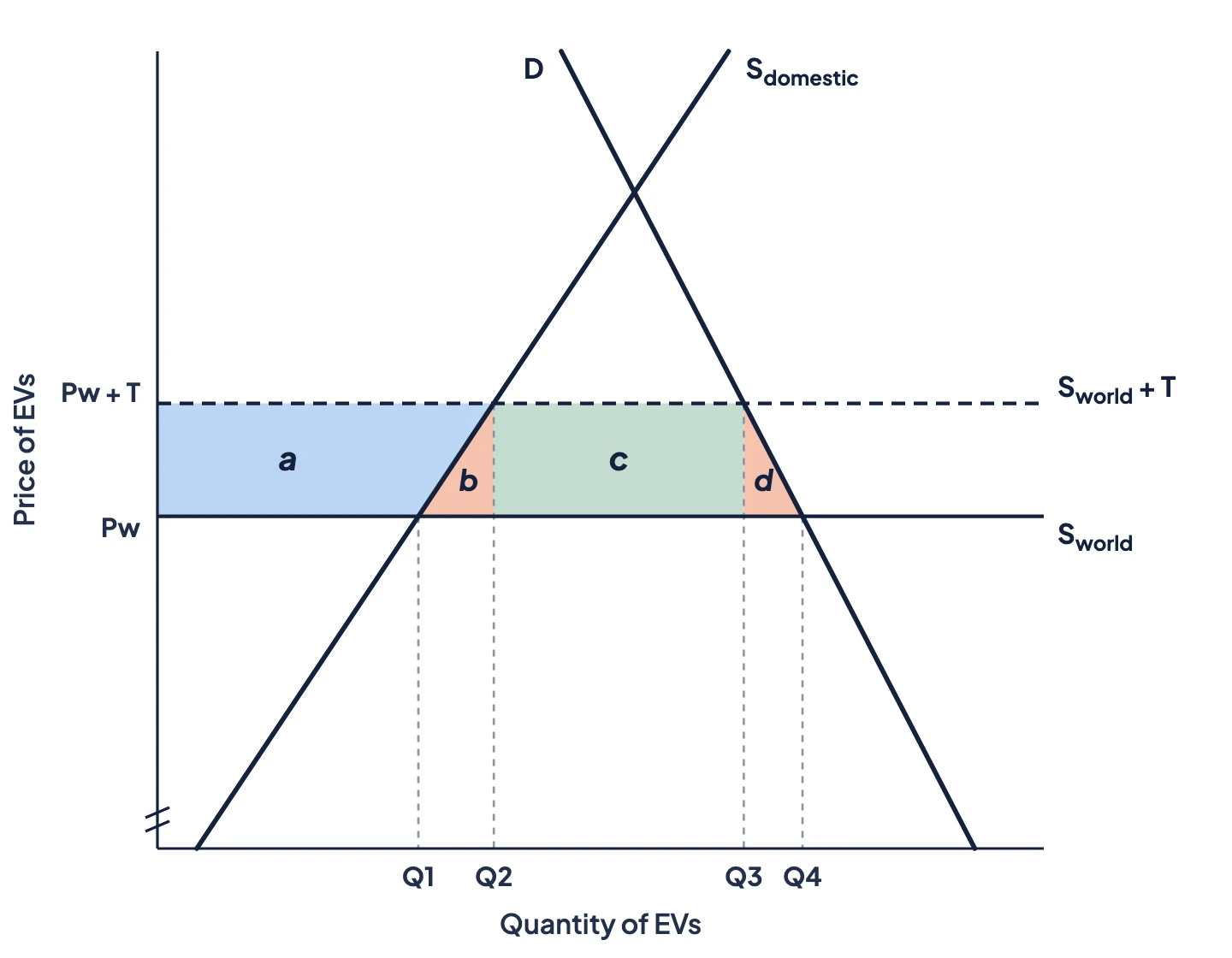
Figure 1 shows the UK market for EVs. Before the tariff, EVs sell at the world price Pw: domestic firms supply Q1, consumers buy Q4 and the difference, Q4 − Q1, is imported. The tariff shifts the world supply curve up by the amount of the tariff, T, so the price rises to Pw + T. Domestic supply rises to Q2, quantity demanded falls to Q3 and imports shrink to Q3 − Q2.
- Price of an EV
- £37,400 (+£3,400)
- Made in the UK
- 68,300 cars (Q2, was 53,000 cars)
- Bought by UK consumers
- 119,100 cars (Q3, was 131,000 cars)
- Imported
- 50,800 cars (was 78,000 cars)
- Gain to UK producers (a)
- £206m
- Tariff revenue (c)
- £173m
- Deadweight loss (b + d)
- £46m
- Loss to consumers (a + b + c + d)
- £425m
At a 10% tariff, an imported EV costs £37,400, imports fall from 78,000 cars to 50,800 cars and the deadweight loss is £46m.
An illustrative model, not a forecast. Only two figures come from the article: the 10% tariff and the £3,400 average rise, which puts the average EV price at £34,000. The demand and supply curves are straight lines chosen to show the textbook effects, so the quantities and the £ millions are examples for the diagram, not estimates of the UK market.
Site diagram after the standard tariff model in the IB Economics guide. Tariff and price rise: Professional Engineering, 18 October 2023.
Stakeholders
In the short term, domestic car makers gain. They sell more cars at a higher price, so producer surplus rises by area a. Higher output raises the demand for labour, which creates jobs in car and battery plants and lowers unemployment. The government also gains tariff revenue, shown by area c.
Consumers lose. They pay more, buy fewer EVs and choose from a narrower range of imported models, so consumer surplus falls by a + b + c + d. The SMMT’s figures assume that foreign producers pass the whole tariff on to consumers. If firms absorb part of it to stay competitive, the price rises less, but their profits fall instead.
Foreign producers sell fewer cars in the UK, so their export revenue falls from Pw × (Q4 − Q1) to Pw × (Q3 − Q2). How far sales fall depends on the price elasticity of demand (PED). Demand for EVs may be relatively inelastic: the SMMT notes that EU–UK trade in electrified vehicles has more than doubled in three years despite the pandemic, semiconductor shortages and trade tensions (“Electric Car Buyers”). If so, imports fall only a little, and the tariff mainly raises prices rather than domestic production.
Evaluation
Society as a whole loses. Area b is the extra cost of producing Q2 − Q1 at home when it could be imported more cheaply, a misallocation of resources, and area d is the satisfaction lost by consumers who are priced out of the market. Together, b + d is the deadweight welfare loss.
The costs reach beyond the car market. Higher EV prices conflict with the UK’s Zero Emission Vehicle Mandate, which requires zero-emission models to make up 22% of new car sales in 2024, rising to 80% by 2030 (“Electric Car Buyers”), so the tariff could slow the switch away from petrol and diesel cars. Because trade flows both ways, UK exporters would face the same 10% tariff in the EU, and the dispute could weaken trade relations or invite retaliation, cancelling out the short-term gains to domestic producers.
Time also matters. In the long run, the rules might succeed: if gigafactories open and local battery supply chains grow, more EVs will qualify for tariff-free trade. Building them takes years, however, which is why the SMMT asked for a three-year delay.
Conclusion
In conclusion, the tariff would benefit domestic producers, workers and the government in the short term, but it would harm consumers and foreign producers and reduce overall welfare through higher prices and a deadweight loss. Because UK and EU car markets are so interdependent, the costs are likely to outweigh the gains. Delaying the stricter rules while battery production in Europe grows, as the SMMT proposes, is the better policy.
October 18, 2023
The SMMT’s warning · London
Car makers estimate that a 10% tariff on EVs failing the stricter battery rules would cost £4.3bn and ask the EU and the UK for a three-year delay.
December 6, 2023
The European Commission proposes a delay · Brussels
The Commission proposes a one-off extension of the existing rules of origin for EVs and batteries until the end of 2026.
December 21, 2023
The EU–UK Partnership Council agrees · Partnership Council decision No 1/2023
The existing rules apply until December 31, 2026, so EVs keep crossing the Channel tariff-free; the decision calls the extension a one-off.
November 12, 2026
Talks on another delay reported · Brussels and London
The Financial Times reports that the EU and the UK are considering postponing the stricter rules again. No decision had been announced when this page was updated on November 17, 2026.
January 1, 2027
Stricter rules due to apply · EU and UK
Unless they are delayed, an EV must have 55% of its value from the UK or the EU, and its battery pack 70%, to trade without the 10% tariff.
Sources: Professional Engineering; European Commission; UK Government; Council of the EU; electrive, 12 November 2026.