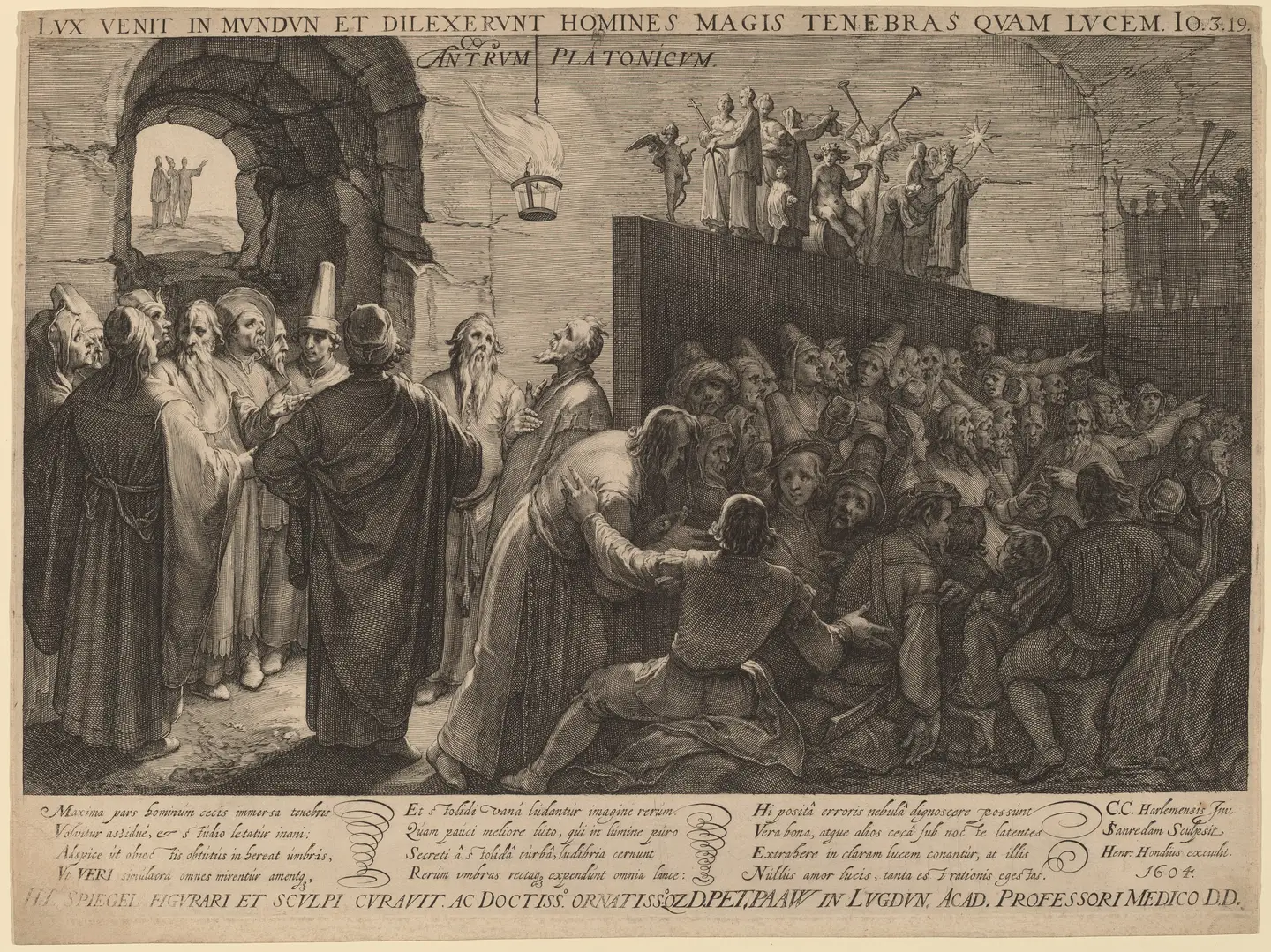
One of the most famous and thought-provoking metaphors in Western philosophy is Plato’s Allegory of the Cave that appears in Book VII of his Republic. The allegory presents a powerful visual and conceptual framework for understanding Plato’s ideas about knowledge and reality as well as human perception. While written in ancient Greece, it presents a powerful framework for comprehending modern life. Individuals today encounter reality through screens and political narratives as well as advertising and social expectations. Such representations can inform understanding but they might also restrict it. Like Plato’s prisoners, people might mistake familiar images for complete truth. The allegory therefore remains crucial since it challenges passive acceptance and explains the discomfort of intellectual growth and presents knowledge as a responsibility towards others instead of just merely a source of personal advantage.
Plato’s Allegory of the Cave starts with a description of prisoners who have been chained inside a dark cave for their entire lives. The prisoners are positioned in a way that they can only see the shadows cast on the wall of the cave by objects behind them that are illuminated by a fire. Prisoners believe such shadows to be the only reality because they have never seen anything else1. When one of them is released, he first finds the light painful and confusing. However, with time, he acknowledges the objects, emerges outside and basically understands the sun’s significance. Such a journey represents movement from limited insight towards deeper understanding. Plato links its highest stage with knowledge of the Good that offers the definitive foundation for understanding and right action.
Social media offers a modern foundational analogy for the cave wall. An individual’s feed presents selected fragments of events and relationships as well as lifestyles, creating an impression of the wider world2. Consider an individual who repeatedly encounters posts depicting wealth as the main measure of success. Without reviewing such assumptions, that person might start assessing personal worth through possessions and public approval. The shadows here are carefully depicted images, while the chains are habits of comparison and uncritical attention. Such an application does not justify that everything said online is false. It rather underscores the danger of treating a partial representation as a complete account of reality.
The allegory also demonstrates misinformation. A narrative appeal can be especially persuasive because it limits counterarguments and inspires the misconstrual of stories as actual memories. Escaping such intellectual confinement demands asking where information originated, what evidence supports it and whether alternative descriptions deserve consideration. Pennycook and Rand support the practical significance of such attention. Their analysis revealed that accuracy prompts enhance participants’ discernment when sharing news3. Applied to Plato’s image, pausing to consider accuracy resembles turning towards the source of a shadow4. Understanding starts when an individual examines how their beliefs were formed rather than automatically accepting impressions.
Plato’s argument also remains crucial in education. He describes education as turning towards comprehending, instead of just storing knowledge inside an empty mind5. In modern classrooms, such a distinction separates memorising information from learning how to examine it. A learner might reproduce an explanation of poverty while remaining unable to examine the conventions behind competing economic arguments. Meaningful education would inspire learners to compare evidence, question generalisations, and acknowledge complexity6. The ascent from the cave hence provides a standard for judging success in education. This means that learning should transform the student’s capacity for judgement, not just increase the quantity of information remembered.
The Allegory of the Cave also clarifies why changing one’s mind can be uncomfortable. The prisoner who was released initially struggles because unfamiliar realities disturb his established expectations7. Moreover, questioning inherited prejudices or political commitments might threaten an individual’s identity and relationships. Someone who challenges a widely accepted community belief might encounter ridicule or exclusion. Such an interpretation suggests that intellectual independence demands emotional courage alongside reasoning. However, discomfort alone cannot establish that a new belief is true. A responsible application of Plato’s allegory requires patient examination of evidence8. This includes evidence against one’s preferred position instead of celebrating disagreement just because it challenges a conservative view or authority.
The return of the prisoner introduces the ethical significance of knowledge. Plato contends that those who reach understanding must return to engage in the community’s affairs. Today, such values can be applied to educators and researchers as well as journalists and other professionals whose expertise carries public consequences. An accountant who understands financial records should explain them clearly enough for others to make informed decisions9. However, the allegory demands caution and shows that individuals who consider themselves enlightened might dismiss legitimate disagreement10. Its modern value is strongest when the responsibility to share understanding is combined with humility and accountability as well as recognition that knowledge remains open to correction.
1Chained, watching shadows
In the allegoryThe prisoners have been chained inside the cave all their lives and can only see the shadows on the wall. They take the shadows to be the only reality.
In the essay, paragraph 3A social media feed “presents selected fragments of events and relationships as well as lifestyles.” The shadows are “carefully depicted images, while the chains are habits of comparison and uncritical attention.”
2Turned toward the fire and the objects
In the allegoryOne prisoner is released. The light is painful and confusing, but he comes to see the objects that cast the shadows.
In the essay, paragraph 4Asking “where information originated, what evidence supports it and whether alternative descriptions deserve consideration”; “pausing to consider accuracy resembles turning towards the source of a shadow.”
3The steep way out
In the allegoryHe is led up and out of the cave, and unfamiliar realities disturb his established expectations.
In the essay, paragraphs 5 and 6Education as “turning towards comprehending, instead of just storing knowledge inside an empty mind.” Changing one’s mind is uncomfortable, and “intellectual independence demands emotional courage alongside reasoning.”
4The sun
In the allegoryOutside, he understands the sun’s significance. Plato links the highest stage with knowledge of the Good, “the definitive foundation for understanding and right action.”
In the essay, paragraphs 2 and 5The essay takes the ascent as a standard for education: “learning should transform the student’s capacity for judgement, not just increase the quantity of information remembered.”
5The return
In the allegoryThose who reach understanding “must return to engage in the community’s affairs.”
In the essay, paragraph 7Educators, researchers, journalists and other professionals whose expertise “carries public consequences” should share what they understand, “combined with humility and accountability.”
The left-hand column restates the allegory as the essay retells it; the right-hand column quotes the essay. Nothing here comes from outside the paper except the layout.
Drawn by the site from the essay’s own wording; the quotations are from paragraphs 2 to 7 of the paper. The retelling of the allegory follows Plato, Republic 514a–517c (Jowett’s translation, Project Gutenberg).
In conclusion, Plato’s cave is still useful in modern days because it directs attention towards the limits of ordinary observation. Its contemporary equivalent comprises curated images and unquestioned assumptions as well as information accepted without scrutiny. Leaving such caves demands critical education, careful attention, and a willingness to revise familiar beliefs. Yet the journey should not inspire intellectual superiority. Individuals who gain understanding also receive commitments to communicate honesty and support others’ judgments. The enduring lesson is hence both intellectual and ethical.