Introduction
Deforestation is a condition in which forest cover, including vegetation, is destroyed due to human activities such as agriculture, industrialization, settlements, and urbanization without taking any mitigating measures such as tree planting (Sajo 2024, p. 1; Azeez 2023, p. 75). However, biodiversity is the diversity of life on earth comprising ecosystems, species and genes (Azeez, 2023, p. 76; Cook, 2020, p. 93). The main argument presented in this paper is that deforestation, driven by a wide range of pressures across different locations, leads to the erosion of diversity at three main levels: habitats, species, and genes. It further argues that although policies exist to address these issues, gaps exist, allowing deforestation to persist.
Causes of Deforestation
The causes of deforestation differ from one place to another. Aziz and Bilal (2025) noted that commercial cultivation of crops, especially oil palm trees and the grazing of cattle, contributes to about two-thirds of the total deforestation in the tropics (p. 42). Humans can easily carry out these activities due to weak environmental laws, new infrastructure, and global market pressures. In some areas, smallholders clear forests to make way for agricultural land due to poverty, population growth, and unclear land tenure. The research conducted in Kwami, Gombe State, found that 39% of the deforestation incidents reported were attributed to farming activity, 14.25% to construction, and 46.75% to other causes (Sajo, 2024, pp. 3–4). Deforestation was also caused by the population increase, fuel wood, hunting and bush burning.
Conversely, quantitative studies in Lagos State by Azeez (2023) revealed that poverty (27%), urbanization and industrialization (23%) and lack of awareness through educational campaigning (11%) are the common factors implicated in the deforestation. These studies collectively agree that large corporations clear forests to create industrial infrastructure. In contrast, poverty, which pushes households to cut down trees to sell wood and charcoal for income, drives forest clearing.
Effects of Deforestation on Biodiversity
Deforestation directly affects habitats which contribute significantly to the displacement of animal and plant species (Azeez, 2023, p. 79). Species with habitat preferences will become fragmented and isolated in the absence of the habitat, thus placing them at risk for extinction. For example, in the Amazon, which is home to many rare species, deforestation is driving species to extinction that would not thrive elsewhere. Fragmentation and isolation also cause loss of genetic diversity within a species, which hinders their readiness to rapidly adapt to changing environmental conditions and exposes them to disease and environmental stressors (Cook, 2020, p. 95). Forest-dwelling species, especially those that shelter, feed, and reproduce from the forest, are over-affected, resulting in biodiversity loss overall (Cook, 2020, p. 95).
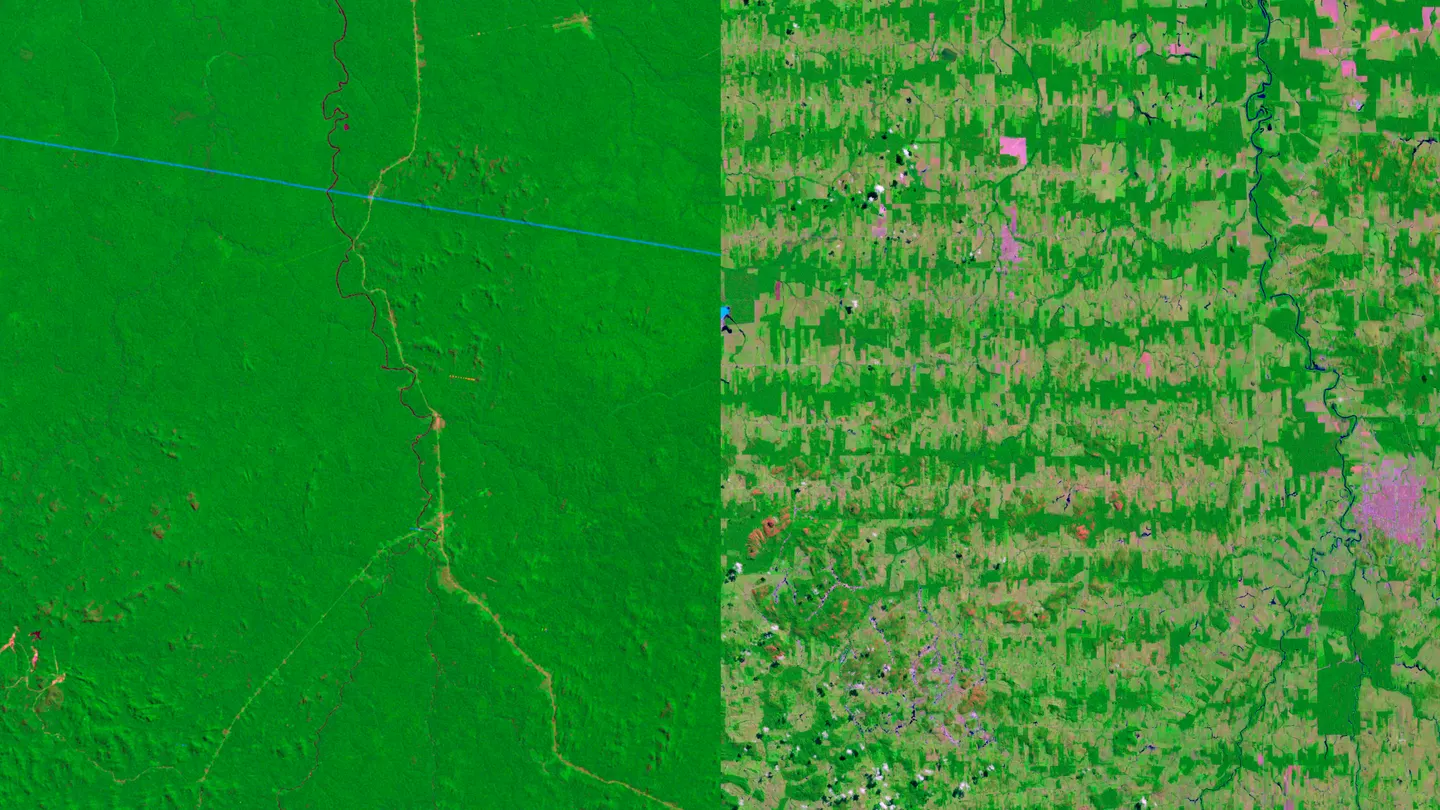
Further, quantitative research shows that areas of deforestation are going down in species diversity. Aziz and Bilal (2025, p. 40) reported that the land surface of the earth is approximately 6% covered by tropical forests and harbors approximately 50% of the terrestrial biodiversity of the world. Yet, 137 rainforest species are going extinct every day because of deforestation. Moreover, deforestation hinders essential ecosystem relationships. The fragmentation occurs when continuous areas of woodland are divided into smaller patches. This leads to increased impacts on big bodied and specialized mutualisms, leads to issues with pollination, seed-dispersal, predator prey interactions and others. Indigenous homes are destroyed through deforestation. Consequently, opportunities to access plants and animal species for economic, research and medicinal use are denied.
In Pinho et al. (2025), the authors studied the role of human-induced deforestation on the communities of forest trees in six human-modified forest landscapes of the Amazon and Atlantic Forest areas of Brazil. They surveyed 271 plots of old-growth forest with 28,565 trees of 1,207 tree species. Within every scenario of forest loss, the proportion of the forest traits of winners (low density wood tissue and small seeds) increased. At the same time, the number of trees showing high wood density and/or large seeds (loser traits) decreased. On average, approximately 8% of species were the winners, 20% losers, and the majority were neutrals. Forest loss alone accounted, on average, for 20% of the variation in community traits (Pinho et al., 2025, p. 282).
The study done by Bourgoin et al. (2024, p. 570) used two datasets to perform the statistical analysis of the effect of deforestation-initiating activities on canopy height: biomass measurement data and forest cover change observations. They noted that degradation is going on as fast as the destruction of forests and that in some years it has gone at a higher rate than forest removal. A reduction in canopy height estimated at 15% and 50% respectively by selective logging and burning. Besides, farm operations and roads affected the forest edge to the extent of 20-30 percent. Edge effects reached as far as 1.5 km from forest edges. Edge effects involved around 18% of the area covered by tropical rainforest, and the extent was around 206 million hectares (Bourgoin et al., 2024). Little recovery was observed 20-30 years later after an edge had formed but none was observed 10 years after fire. After 10 to 15 years, regrowth around 60% of the canopy had returned in deforested plots, whereas after 20 years only about 43% of the biomass had regrown. It is estimated by the authors that the complete reconstruction process will take around 100 years following deforestation or degradation. Bourgoin et al. (2024, p. 570) found that degraded forests with more than 50% canopy loss are significantly more vulnerable to subsequent deforestation.
All causes
2,664,576 hectares in 2002; 6,733,300 in 2024, the most in the series; 4,287,849 in 2025.
Loss to fires
166,923 hectares in 2002; 3,249,037 in 2024, almost half of that year’s loss; 1,618,245 in 2025.
Loss is the removal or death of tree cover from any cause, so it is not the same as deforestation. The figures from 2011 on were made with an updated method, so compare them with the earlier years with caution. Some of the fire loss counted in 2025 happened in late 2024 and was seen late because smoke and haze delay satellite detection.
Chart by Writers Per Hour from the World Resources Institute’s Forest Pulse (Global Forest Review, updated 29 April 2026), which uses the University of Maryland GLAD lab’s tree cover loss data (Hansen et al. 2013, CC BY 4.0) and its primary forest map (Turubanova et al. 2018). The paper does not cite these figures.
Show the loss for every year
| Year | All causes | Loss to fires |
|---|---|---|
| 2002 | 2,664,576 | 166,923 |
| 2003 | 2,486,989 | 192,104 |
| 2004 | 3,398,616 | 200,938 |
| 2005 | 3,329,538 | 263,041 |
| 2006 | 2,813,543 | 209,915 |
| 2007 | 2,904,252 | 337,937 |
| 2008 | 2,713,684 | 189,285 |
| 2009 | 2,801,437 | 173,638 |
| 2010 | 3,306,113 | 423,315 |
| 2011 | 2,750,624 | 252,043 |
| 2012 | 3,596,144 | 290,881 |
| 2013 | 2,639,101 | 183,676 |
| 2014 | 3,587,363 | 301,769 |
| 2015 | 2,932,063 | 316,296 |
| 2016 | 6,128,135 | 2,357,745 |
| 2017 | 5,001,643 | 1,163,347 |
| 2018 | 3,648,015 | 441,724 |
| 2019 | 3,751,047 | 561,862 |
| 2020 | 4,209,902 | 1,007,056 |
| 2021 | 3,749,200 | 618,972 |
| 2022 | 4,116,764 | 591,066 |
| 2023 | 3,737,837 | 691,726 |
| 2024 | 6,733,300 | 3,249,037 |
| 2025 | 4,287,849 | 1,618,245 |
Conservation and Policy Measures, and Remaining Gaps
Several measures have been implemented and adopted to slow deforestation. Marking of protected areas and indigenous territories is a key measure that has reduced human activities such as logging. Tree planting programs implemented in different countries have been adopted. At the same time, certification schemes and international treaties have been adopted as a way of protecting forest cover (Aziz and Bilal, 2025, pp. 51–53). Other measures that have been recommended include practicing agroforestry and public awareness campaigns. Despite these measures, deforestation still continues to be a serious issue globally. However, this is due to the numerous gaps that exist, such as weak governance, inadequate funding, and conflicting incentives that contribute to a reduction in the forces of policies. Another gap that exists is poverty, where some households continue to use wood and charcoal to generate revenue, and they keep on clearing forests when there are no alternative ways of generating income (Aziz and Bilal, 2025, p. 42). Furthermore, there is limited data on deforestation since the main causes and degree of deforestation have not been recorded for years, thus limiting the number of solutions that researchers can provide.
Conclusion
Deforestation negatively impacts biodiversity since it causes species isolation, removal of their habitat, and weakens their genetic health. Even though indigenous land rights have been developed, protected areas marked, and replanting days as a way of restoring forest-cleared areas, small protected areas, weak governance, and thin local data hold this back.