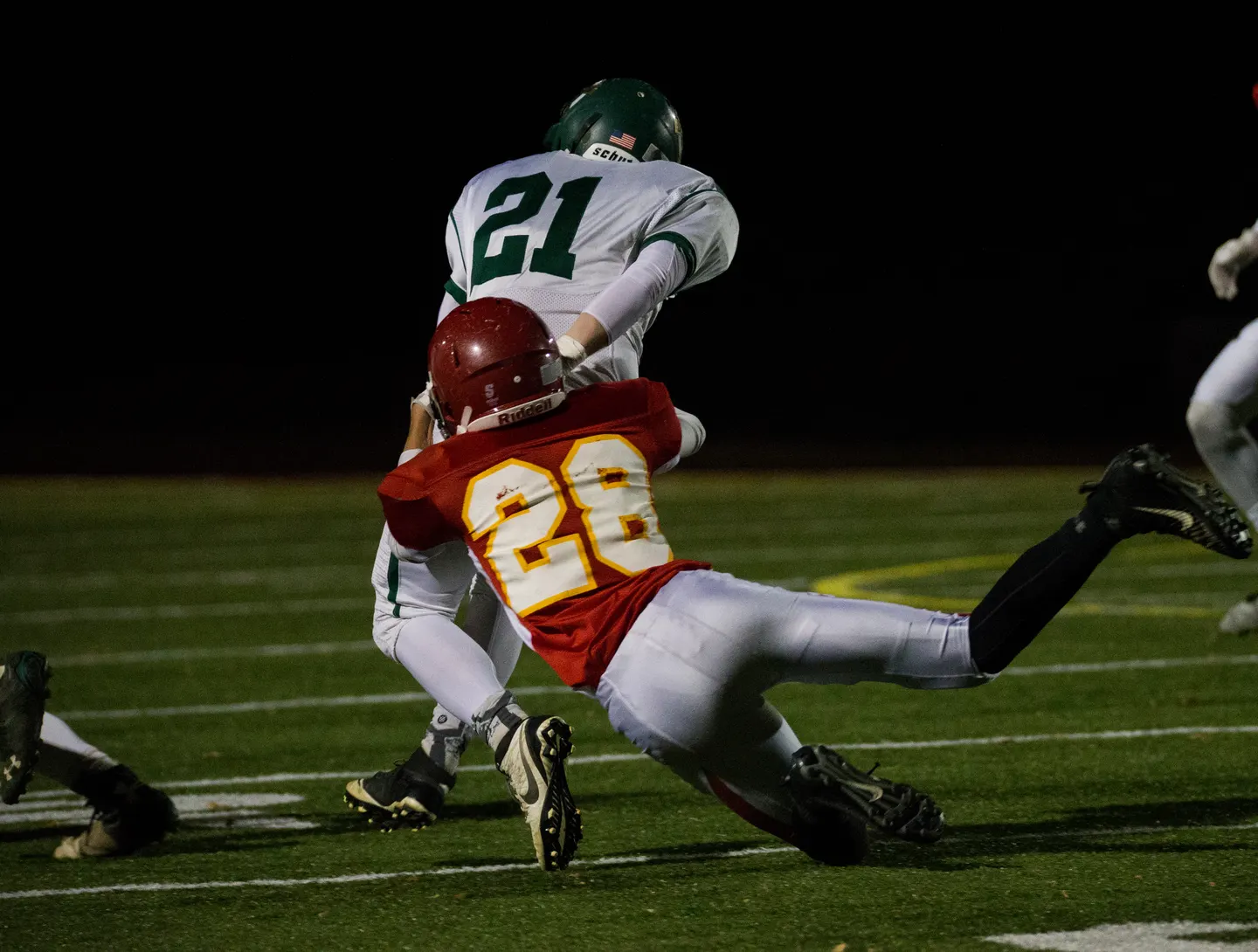
Each fall, millions of Americans fill stadiums and living rooms to watch football, which is deeply ingrained in the identity of towns, universities and the entire country. The weekly routine of Friday night high school games, Saturday’s college showdowns, and Sunday’s pro matches boosts local economies and provides a familiar ritual for communities. Each season also produces the same dreaded scene, a player lying on the field, trainers running onto the field and the crowd silent. In the last 20 years, those moments have become not an accepted cost of the game but a public health issue. Research now associates repeated head blows with a progressive brain disease and this has become known to players at all levels, not just the professional level, but to teenagers and young adults as well (Concussion & CTE Foundation, 2026). The question is whether the danger is worth it, whether the science reflects it and whether the changes have been accomplished and who is supposed to take the risk. In this essay, I assert that the risks of football are something that can be taken by the adult professionals. However, any evidence that the harm may start in childhood renders the sport as organized as it is not worth the risk for young participants and reform should be assessed on the basis of outcomes, not assurances.
What the Evidence Shows
Chronic traumatic encephalopathy (CTE) is a progressive brain disease that occurs after repeated blows to the head, and can only be diagnosed after death. Boston University neuropathologist Ann McKee led a 2023 study in the Journal of the American Medical Association (JAMA) Neurology that included 152 brain donors who had participated in contact sports and passed away before age 30. The research found that 63 of them, which was approximately 41%, had CTE. Three-quarters of those with CTE were football players according to the National Institutes of Health (2023). The institute also found that over 70% of donors who had CTE had played only at the amateur level, defying the notion of serious brain damage only occurring in professional careers.
There are some limitations in the findings. The National Institute of Neurological Disorders and Stroke (2023) emphasized that such research wouldn’t necessarily reveal the prevalence of CTE among athletes because the donors were not random. More recent research, however, agrees: A 2026 research study in the Journal of Neurotrauma that examined 677 deceased former football players reported 70% had CTE. Within the age 60+ cohort of those who died, the odds of having memory problems interfering with daily functioning were 10% higher for every year younger a player started playing tackle football (Concussion & CTE Foundation, 2026). The researchers found no correlation with presence of CTE and starting age, but they did find a correlation with symptoms, and suggested that head impacts in childhood may have a delayed effect (Concussion & CTE Foundation, 2026).
Donated brains with CTE, by highest level of play, %
- National Football League: 99 %.
- College: 91 %.
- Canadian Football League: 88 %.
- Semiprofessional: 64 %.
- High school: 21 %.
- Before high school: 0 %.
Read the bars as what was found in donated brains, not as how common CTE is among players: families of players who had symptoms were more likely to donate, so the sample is not random, and the study’s authors say so. The paper does not cite this study. Eleven of the 14 high school players and 5 of the 53 college players had no CTE; the two brains from before high school had none.
Chart by Writers Per Hour from Mez et al., “Clinicopathological Evaluation of Chronic Traumatic Encephalopathy in Players of American Football,” JAMA 318(4), 2017 (abstract, checked against PubMed and Crossref). The study reports 177 brains with CTE among the 202 studied. Figures are used here as published; the paper does not cite them.
Show every figure as a table
| Highest level played | Share with CTE (%) | Brains with CTE | Brains studied |
|---|---|---|---|
| National Football League | 99 | 110 | 111 |
| College | 91 | 48 | 53 |
| Canadian Football League | 88 | 7 | 8 |
| Semiprofessional | 64 | 9 | 14 |
| High school | 21 | 3 | 14 |
| Before high school | 0 | 0 | 2 |
Progress and Its Limits
Football defenders do have a good point. It provides discipline, scholarships and community to millions and the National Football League (NFL) has acted in response to evidence to make measurable change. At the league level, the number of concussions reached its highest in 2017 (281) and its lowest in 2024 (182) since they were first captured in 2015 (Gambacorta, 2025). Better helmets, padded helmets worn over helmets in practice and a new kickoff design were given as credit. They also found that collisions between helmets at speeds faster than 15 mph were 26 times more likely to cause a concussion (Gambacorta, 2025). That’s a significant discovery because it indicates that risk is focused in specific types of plays that can be targeted by rules and equipment.
Concussions counted by the NFL in the season, concussions
- 2017 season: 281 concussions.
- 2022 season: 187 concussions.
- 2023 season: 219 concussions.
- 2024 season: 182 concussions.
Only four seasons are shown because only these have a figure in the sources read; the seasons between are left out rather than guessed. The league counts more than it used to (doctors evaluate three or four players for every diagnosis), and these counts cover concussions in games and practice, not rates per play. The paper cites only the 2017 and 2024 figures.
Chart by Writers Per Hour from Gambacorta, The Philadelphia Inquirer, 31 January 2025 (2017, 2023, 2024), the NFL’s 2024 season release (what is counted, tracking since 2015) and the Associated Press, “NFL says the preseason saw its fewest number of concussions since tracking started,” 4 October 2024, which gives 187 for 2022.
Show every figure as a table
| Season | Concussions | What the source says is counted |
|---|---|---|
| 2017 season | 281 | “Reported concussions”; the peak year (Gambacorta, 2025). The article does not say which games or practices are counted. |
| 2022 season | 187 | Preseason and regular season, practices and games; the lowest before 2024, not counting 2020 (Associated Press, 2024). |
| 2023 season | 219 | Preseason and regular season, practices and games; the 2024 total is 17% below it (Gambacorta, 2025). |
| 2024 season | 182 | Preseason (three games) and regular season (17 games), practices and games; the lowest since 2015 (NFL; Gambacorta, 2025). |
However, there’s not as much to be cheerful about as the 2024 press release implies. Concussions on kickoffs rose from 8 to 35 as returns became more common under the new format, and in-game concussion evaluations reached a league record 538 (NFL, 2026). The league says the per-play concussion rate on kickoffs is still below that of the old format and the overall injury rate stayed stable (NFL, 2026). A high evaluation count may also mean that players are sticking to their sidelines – a positive sign. However, “steady” does not equate with “safe”. CTE injuries are only counted in the event of a diagnosis and researchers have determined that cumulative repetitive head injuries are the top risk factor for CTE (Concussion & CTE Foundation, 2026). A league can reduce the number of concussions, but still allow players to be accumulating what’s most important, cumulative exposure.
Who Chooses the Risk?
Football is a dangerous game, and the sense of danger is driven by the acceptance of the players. Professional adults are paid, educated, and empowered to choose, and a sensible adult might determine that the benefits outweigh the potential risks, particularly as equipment and the rules are enhanced. Children are in a different situation. They are unable to meaningfully assess a risk whose effects may manifest in half a century and evidence indicates that their developing brains may be particularly susceptible (Concussion & CTE Foundation, 2026). The damage isn’t limited to those whose job it is to take it. The cost is particularly borne by players who never received a professional salary, since most of those with CTE in the 2023 study were only amateur players (NIH, 2023).
Luckily, exposure is a factor that communities can manage. The only known risk factor for having CTE (Concussion & CTE Foundation, 2026) is years of football participation. If the sport is left for the adolescents, if the number of contacts is limited in practice, and if flag football is provided to younger kids, then the amount of exposure should be lessened without the sport being eliminated. The researchers of the 2026 study even said that the goal for youth sports policy should be to limit exposure to repetitive head impacts (Concussion & CTE Foundation, 2026).
Conclusion
Football is not just worth the risk, it’s either worth the risk or it’s not worth the risk. This is a question which depends on who plays, how long they play and whether the sport takes what it learns seriously. The risks are justifiable for consenting adults. Professionals are paid, informed and free to choose, and some metrics indicate that the danger is going down (but not always), as evidenced by the mixed results of the 2024 and 2025 NFL seasons. The evidence is currently inconclusive and children should be warned. It is not something that can be calculated by young players, and research indicates that beginning tackle football at an early age may be correlated to reduced brain health later in life. The best answer is neither “abolish football” nor “traditional football”. Instead, it is to adopt the same standard of success as tackling at a later age, less contact in practice, and increased flag football participation. The study has some limitations. Brain donor studies cannot provide an estimate of the prevalence of CTE in all players and ongoing, independent research into risks and reforms is necessary. A good game is one that is ready to be altered by the knowledge it gains of players.