
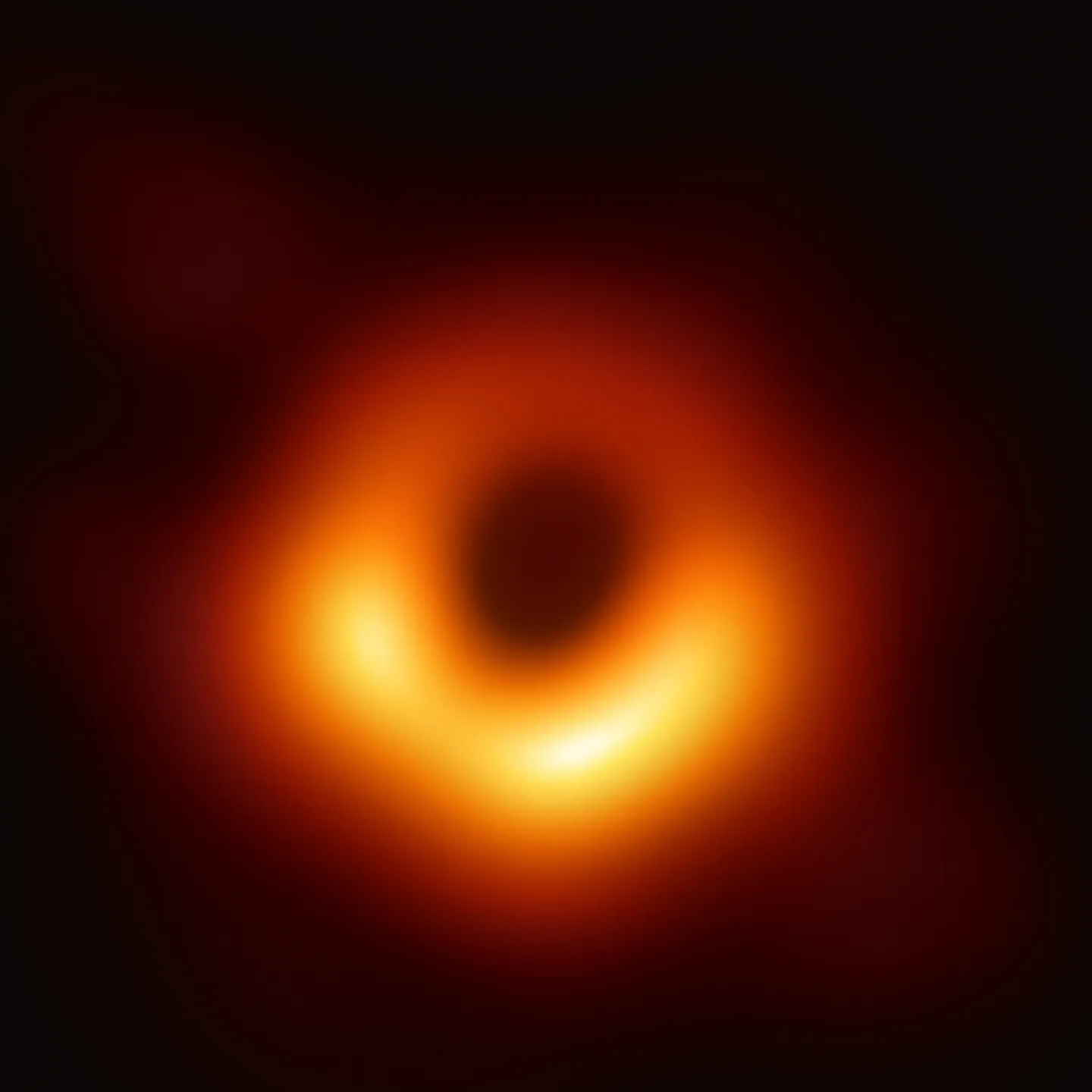
A black hole is an area of space in which gravity is so intense that not even light can escape. Until the 1970s, black holes were only theoretical objects. Today, black holes are of great interest to astronomers and physicists. Scientists have now been able to get a picture of the glowing ring around a black hole, record gravitational waves produced by binary black hole mergers, and trace the orbits of stars around a massive compact object at the heart of our galaxy. But the mysteries surrounding the nature of black holes are by no means less fascinating. Could black holes make up some of the dark matter? What will black holes do to information they ingest? This essay explores what scientists currently know about black holes and what they still do not understand about them.
The Formation of Black Holes
A stellar-mass black hole forms when a very massive star can no longer resist the force of gravity. However, some black holes might have formed in processes unrelated to stars. Several journal articles have discussed how such black holes could form. Harada (2024) explained that primordial black holes (PBHs) might have formed from large density fluctuations in the early universe. These fluctuations may have come from quantum fluctuations during inflation, a phase of very rapid expansion shortly after the Big Bang. Özsoy and Tasinato (2023) also linked the creation of PBHs to cosmological inflation, which can amplify these fluctuations enough for PBHs to form. Interestingly, because their mass depends on when they formed, PBHs could have a very wide range of masses, from less than the mass of an asteroid to that of the supermassive black hole at the center of our galaxy. PBHs with the mass of an asteroid could still account for a large part, or even all, of the dark matter (Özsoy & Tasinato, 2023).
Observing the Invisible
Light cannot escape from a black hole, so black holes cannot be seen directly. However, some properties of black holes can still be observed. For instance, telescopes can capture an image of the glowing ring around a black hole. Javed et al. (2021) calculated the shadow of a tidal charged black hole, a model from theories with an extra dimension, using the null geodesic equations of light, and compared its size with the shadow of the supermassive black hole at the center of the galaxy M87 measured by the Event Horizon Telescope (EHT). The researchers found that the radius of the shadow depends on the mass of the black hole and on its tidal charge: the larger the tidal charge, the smaller the shadow. Another way to observe black holes is to detect the gravitational waves produced by binary black hole mergers. Gravitational waves are ripples in spacetime caused by accelerating masses. Detecting them lets scientists study black holes in close binary systems, including their masses and spins (Harada, 2024).
What We Still Do Not Know
Modern physics can make amazing statements about the nature of black holes, but it is still far from understanding some of their aspects. First of all, it remains unclear how the supermassive black holes in the centers of galaxies formed. PBHs could have been the seeds of supermassive black holes, but it is still unknown how much of the dark matter they make up: observations rule out PBHs of about the mass of the Sun as most of the dark matter, while much lighter PBHs could still account for all of it (Özsoy & Tasinato, 2023). Another open question is how and when PBHs formed, if they formed at all. Harada (2024) noted that these objects probably formed either during the epoch of radiation domination or during an epoch of matter domination. The epoch matters for their initial spin: PBHs formed during radiation domination should spin very slowly, while those formed during matter domination can spin fast. Spin is an important property for finding PBHs with current technology, because gravitational-wave observatories measure the spins of merging black holes, and spins unlike those of black holes formed from stars could show that a black hole is primordial (Harada, 2024). The final mystery discussed here is the information paradox. Quantum theory says that information cannot be destroyed. However, it is not known what happens to the information about the matter that falls into a black hole once the black hole evaporates. According to quantum field theory in curved spacetime, black holes slowly lose mass by emitting Hawking radiation and may eventually evaporate completely (Harada, 2024). This paradox needs to be solved in order to combine the laws of quantum mechanics and gravity.
Conclusion
Black holes were once only a prediction; now they are an observed fact. Astronomers and physicists were both instrumental in the development of the current understanding of the nature of black holes. The observational technology and mathematical models developed so far will help scientists keep studying black holes. Today it is known that there are stellar-mass black holes and supermassive black holes, while primordial black holes are still a hypothesis. With the aid of modern telescopes and instruments, physicists are able to observe various properties of black holes. Unanswered questions about black holes include how they formed, how they are related to dark matter, and the information paradox. Future research on these subjects will help humanity learn even more about the nature of the universe. Perhaps some of this knowledge will be gained soon, as new facilities for black hole research are being built.